 Back in my day... music was analog. Anything you hear from 1949 flowed through tubes. Funny how there are heated arguments today about the superior of tubes to solid state and vinyl to CD. The truth is that the majority of people have a limited range of hearing, relatively lousy speakers, and not the best places to listen to recordings, so the slight differences aren't that much.
Synthesizers were not part of the music world back then; there were a few pioneers like Raymond Scott, but on the whole sounds were created the way they had been for hundreds of years. There were electric guitars, but were mostly used as rhythm instruments. The revolution of guitar-based bands was yet to come. The electric guitars at the time were usually large acoustic models retrofitted with a "lipstick" pickup.The widespread us of solid body instruments, pioneered by Les Paul and Leo Fender, was years away, and then it took a few decade for modern guitar sounds to come along, as the technology expanded and musicians discovered the creative possibilities.
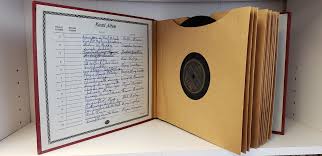
Records were 78s, with a short play length and limited range of frequencies and dynamics. If an artist had a longer work or many songs, they would be presented in an "album", which was like a book containing many 78s (see illustration). They were easily broken, susceptible to scratches and other damage, and gradually lost fidelity over repeated playing. They used a fat needle on a heavy tonearm.
In the early 1950s, the 45 format (for singles) and the 33 (LP) format for albums, which now could be made on a single record. The next step was the shift to digital media. When the CD format was developed, the president of Sony wanted the entire 9th symphony of Beethoven to fit on a single disc, so 74 minutes became the default length. The difference between vinyl and cd decreased as the technologies and recording techniques evolved, but there are zealots on both sides that will point out the superiority of one over the other. But for most people (without $50,000 home systems and amazingly good ears), the difference is slight.
Finally, we come to MP3s and streaming audio. As with other technologies, the first attempts left a lot to be desired, but they have improved greatly over the years. The problem is a tradeoff between fidelity and time; smaller files mean faster delivery and more capacity. But these saving come at the expense of compressing the recordings, resulting in less information to the ears.
Finally, something should be said about the fate of musicians. There used to be tons of venues for live music, which decreased as easier ways to listen to music in other settings became available. Most movie theaters had live music in the days of silents; ranging from a piano or organ up to a full symphony orchestra; this went away in most cases after sound movies. Other venues included dance halls, night clubs, restaurants, and bars. As live music became more expensive to host, these venues switched to jukeboxes and other sources of recorded music.
100 years ago, the musician's union was very strong and influenced how we listened. By the time I was born, their influence was greatly reduced, and today the only really strong union locals are in New York, Los Angeles, and Nashville (and maybe Las Vegas). There aren't as many opportunities for professional musicians to earn a great living.
And people don't play much music themselves these days. In 1949, you could still walk down the street and hear homemade music coming from houses, not so much any more. In the late 1800s, player pianos appeared, followed by recording, radio, tv, and dedicated music channels. Each of these steps resulted in less home music making. Music is now more convenient to access, but we have lost something in no longer being the direct source of it.
The musician's union always supported the rights of musicians, usually on a very conservative stand. As new technologies were developed, the union worked hard to reduce the negative impact on performers. When player pianos became popular in the late 19th century, which could put some performers out of work, the union fought hard to prevent music to be simply a commodity. Reproducing mechanisms (like the Welte-Mignon system) captured dynamics and tempos, and were much like listening to a recording. The rise of radio brought new challenges a live music was further displaced, and an elaborate licensing system evolved. The current system of streaming audio makes much music essentially free (Amazon Music, Spotify, etc.).