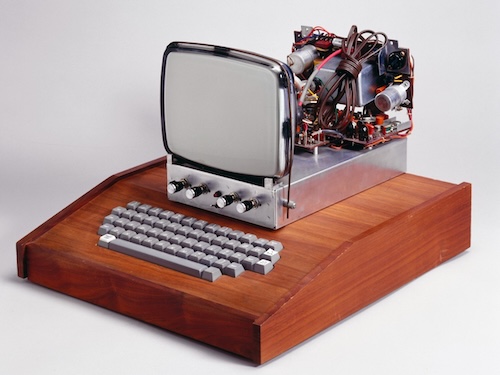
 Back in my day... digital computers were rare. There had been some specialized computers for military and education uses, built using relays, and were very slow (and expensive).
In 1951, The UNIVAC I was introduced, with 6,103 vacuum tubes,[25][26] weighed 16,686 pounds, consumed 125 kW, and could perform about 1,905 operations per second running on a 2.25 MHz clock. The first customer was the Census Bureau.
In 1952, IBM introduced the 701, followed by the 650 in 1954. Programming languages were coming into being. One of the problems with these tube-based computers was they're big, hot, and used lots of power. The biggest problem was once the number of tubes reached into the thousands, the mean time between failure decreased to a matter of minutes and there was considerable downtime. Soon they were replaced by transistors, then integrated circuits.
Computers got bigger and more powerful, but were so expensive few people ever got to use them. In 1974, Popular Electronics magazine ran a cover story on the Altair. It was a kit, with a very sparse memory, but cost $395, which was the retail price of the Intel 8080 microprocessor. It was a huge hit (I bought one) and allowed individuals to have their own computer, which changed everything.
Personal computing brought forth a number of magazines and events like the West Coast Computer Faire, which brought together the underground personal computer movement. Of course on the commercial side, the computers got bigger and more powerful, with large machines from IBM, Cray, Control Data, and others. IBM introduced the 5150, aka IBM PC. It used much of the same architecture of the Altair, but was more solidly engineered. This legitimized personal computing to the commercial world. It was followed by clones from other manufacturers.
In 1975 the 6502 chip was introduced, used by the first Apple Computers. Apple later used the Motorola 6800. Things got faster. Software got better, commuters were more popular, technology kept getting smaller and faster.
Today, my Apple Watch has more computing power than the first mainframes. Businesses are moving from paper to on-line, as computers are integrated into our everyday life.
But that's just the hardware side; there have been a lot of unforeseen consequences to all this power, with opportunities for mischief, identity theft, and all sort of scams.