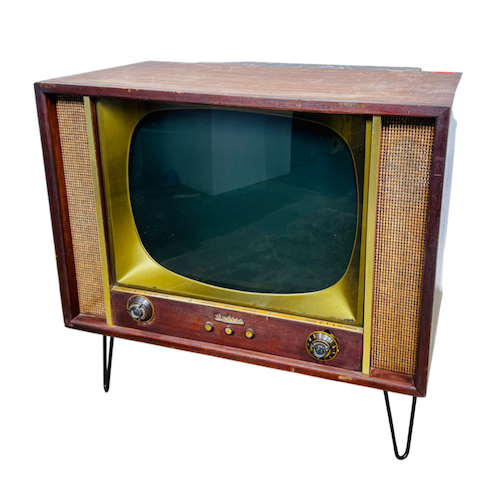
 Back in my day... outside of larger cities, most people could only receive a few TV stations. Black and white, poor quality mono sound. Video recording didn't exist, so no home VCRs.
This also meant the broadcasters couldn't tape delay broadcasts, so things were mostly live. It was tricky to have a national broadcast. Shows would be filmed using kinescopes, essentially a movie camera fitted to a special kind of picture tube. The quality was very poor. A show might originate in New York City, where it would be shown live, and the kinescopes would be sent by mail (airplane or train) to other parts of the country. Pretty lousy for late-breaking news. By the mid-1950s, a coaxial cable and microwave network was set up to directly transmit the video to other parts of the country. This also allowed Hollywood to become a production center.
TV content in 1949 was mostly a shift of radio shows to the new medium. Early stars were veterans of older forms, like vaudeville. There weren't a lot of sets then, so people would often go to public places like bars to watch - this is why boxing and wrestling were so big back then. Lots of commercials for razor blades.
There were also shows aimed at housewives (soap operas, cooking shows, etc.), and children (Howdy Doody, Pinky Lee, the Lone Ranger). Most were loud, obnoxious and had little value other than lowbrow entertainment.
Children's programming slowly got better, with more educational shows like Mr. Wizard, Shari Lewis, and Ding Dong School (which was syndicated with local hosts). But it was still mostly a "vast wasteland", with cheaply made cartoons that were often used to sell cereals, junk food, and violent toys. A big change came later with Sesame Street, that used the selling techniques of commercials to teach and instill good values. This was public television, but as always, the commercial sector tried to cash in with similar shows, most of which weren't quite as successful.
The sets in the late 1940 were pretty small, starting at seven inches, with a round picture. My uncle Herb had the first set in our family, and was advised that viewing should be done by a certain distance, one foot away for each inch of picture tube. His first set was seven inches, not a problem. Then they got a 10 incher, and a 12 incher. By then the the rules were forgotten.