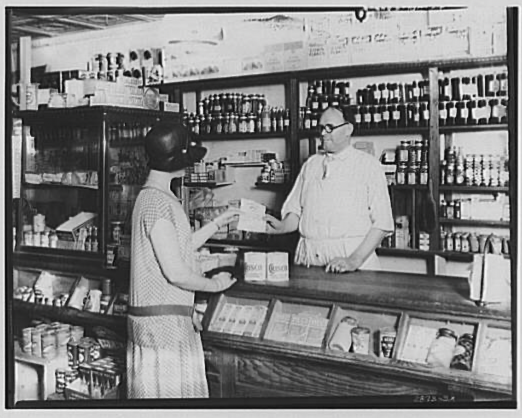
 Back in my day... shopping was going through a transition. Self-service shopping was catching on big, but there were still businesses where you'd go in with a shopping list, tell the clerk what you wanted, and they would pick it for you. Pretty inefficient. Sometimes the clerk wouldn't even ring you up at the cash register, out have payment taken care of by another employee. At the JC Penney we went to, you would hand money to the clerk, who would put it in a pneumatic tube, where it would be sent to the counting department, and return with your change and receipt. When I lived in St. Kitts, there was a store that harkened back to Victorian times, where you would get your order together, then the clerk would take your money to the person (in a cage) who dealt with payment. In the old days, this was done to prevent theft by clerks.
If you look at photos of old stores, you'll see a clerk at the counter, with the goods behind them, as in the above photo. Piggly Wiggly was one of the first grocery stores to allow self-service shopping, and it rapidly caught on. It reduced overhead for the store and allowed customers to examine goods better. Scanners were introduced in the 1970s, speeding things up and were also more accurate. This has devolved into self-checkout, which is frustrating and removes human contact from the equation. This is being seen as a failure in most places.
Of course there was no online shopping in the old days. That didn't really catch on until the mid-1990s, with outfits like Amazon and eBay. It took a while for payments to become secure, but now online is a huge part of the economy. Fine if you know what you're looking for, but no human contact and browsing is more difficult.
There are some strange hybrids, like InstaCart, where you purchase online but a human does the actual picking and delivery. Sort of works. Was a big deal during the pandemic, but more expensive (you need to tip plus pay a delivery fee), and again, little human interaction compared to regular shopping.
Payment was different in 1949; it was pretty much all cash. There were no credit or debit cards. Going to the store with my mother in the 1950s, she paid cash, or once in a while a check. When my dad deposited his paycheck, he would withdraw enough cash for groceries and other things we needed. It was still common in 1949 for grocery stores to deliver to the home. If you were an established customer you could charge it and settle up later. And even when credit cards became available around 1960, a single woman could not get one until 1974.